
For companies, it is important to precisely analyze the specific requirement of their cooling needs and strategically select the appropriate cooling solution. To ensure efficiency, reliability, and cost-effectiveness, the right choice must be made between mobile cooling units and stationary systems. In this article, we explain when a mobile unit is worthwhile and how it works.
Mobile Cooling Technology: Crucial for Many Sectors
From food preservation to the cooling of complex industrial processes: Cooling technology plays a crucial role in many sectors. In addition to permanently installed systems, mobile units also play an important role due to their flexible applicability.
In this article, we want to provide you with a comprehensive understanding of mobile refrigeration units and insights into their definition, functionalities, and areas of application. To highlight the advantages and disadvantages of mobile systems and their role in modern cooling technology, we will also differentiate them from stationary cooling untis.
What Is a Mobile Cooling Unit?
Unlike permanently installed systems, mobile cooling units can be flexibly transported and operated at various locations.
The term “mobile cooling unit” encompassed various types of devices. These include:
- Mobile air conditioners: Mobile air conditioners are smaller units used for air conditioning individual rooms in homes or commercial premised. They are designed as sinlge or split units.
- Mobile industrial refrigeration units (chillers): Chillers are more powerful and significantly larger than air conditioners. They are often used in industry and commerce – either as compact units or as modular systems.
Most cooling systems are designed as reversible heat pumps, meaning they can not only cool but also heat. They are therefore particularly suitable when both cooling and heating are required. There are also mobile cold buffers that store excess energy, which can be released when needed.
Therefore, the definition of a mobile cooling unit is not limited to its physical mobility, but also to its ability to flexibly respond to changing cooling needs and to provide temporary or supplementary cooling services.
How Does a Mobile Cooling Unit Work?
Like most stationary systems, the operation of mobile cooling units is based on refrigerants. A refrigerant absorbs heat through evaporation and releases it through condensation. It goes through four main phases:
- Evaporation: In the evaporator, the liquid refrigerant absorbs ambient heat at low pressure and low temperatures, evaporating and becoming gaseous.
- Compression: A compressor draws in the gaseous refrigerant and compresses it. This increases the pressure and temperature of the refrigerant.
- Liquefaction/Condensation: in the condenser, the high-pressure compressed refrigerant gas releases the absorbed heat to a cooler medium and liquefies again.
- Expansion: An expansion valve expands the now liquid refrigerant, drastically reducing pressure and temperature. The cycle begins anew in the evaporator.
There are two types of mobile air conditioners:
Single Unit Air Conditioners
Single Unit air conditioners are the most common type among mobile air conditioners and are particularly popular in private and small commercial areas. All components of the refrigerant circuit (evaporator, compressor, condenser, and expansion valve) are housed in one casing.
Functionality: In a single unit air conditioner, warm room air is drawn in an passed over the compensator, where it is cooled. The cooled air is then blown back into the room. An exhaust hose directs the waste heat, typically through a window or door, outside.
Advantages:
- Easy installation
- No permanent fixtures required
- Easy to transport
Disadvantages:
- Lower efficiency (warm outside air can flow in)
- Higher noise levels
- Less flexibility due to exhaust hose
Split Units
Split Systems air conditioners consist of two separate units: an indoor unit (evaporator) and an outdoor unit (condenser). the two components are connected by a refrigerant line.
Functionality: The indoor unit extracts heat from the room air. The refrigerant transports it to the outdoor unit. This unit releases the absorbed heat to the environment. Since no exhaust hose is required, split units are particularly efficient.
Advantages:
- High cooling capacity & energy efficiency
- Low noise levels indoors (compressor is housed in the outdoor unit)
Disadvantages:
- More complex installation than single unit air conditioners
Mobile Chillers
Mobile chillers are a special category within mobile refrigeration systems. They are designed to cool liquids (usually water or a water-glycol mixture), which are then used for temperature control in various processes or systems.
Advantages:
- High cooling capacity
- Precise temperature control
- Flexibility and scalability
- Versatile areas of application
Disadvantages:
- High energy consumption
- High space requirements
- Noise generation
- Complex installation
Where Are Mobile Cooling Units Used?
Regardless of their design, mobile refrigeration units are intended to provide effective and demand-oriented cooling where permanently installed systems are not possible or practical. Examples of use include:
- Industry & Production: In industrial manufacturing processes, precise temperature control is often crucial for product quality or machine efficiency. Here, refrigeration units are primarily used to dissipate process heat, cool machines, or regulate the ambient temperature in production halls. Mobile systems become relevant for temporary production peaks, the failure of existing cooling systems, or during maintenance work that requires a temporary solution. Another application area is the cooling of server rooms and other IT infrastructures that require consistently low temperatures.
- Events and temporary accomodations: At events such as trade fairs, concerts, or sports events, air conditioning of tents or halls is often necessary. Mobile cooling units can be quickly installed here and dismantled again after the event.
- Emergency cooling: The failure of a permanently installed refrigeration unit has serious consequences in many industries. Mobile refrigeration units are suitable for minimizing downtime and ensuring business continuity.
- Seasonal peak loads: Some processes are subject to seasonal fluctuations in cooling demand, for example, during the summer months. Instead of investing in stationary systems that are not to hardly needed for most of the year, companies can rent mobile cooling units and thus optimize expenses and resource utilization.
- Food industry: To ensure the quality of food products, maintaining specific temperature ranges during production and storage is important. Mobile cooling units offer a temporary solution for storage rooms or in the event of failures or conversions of cold storage facilities.
- Construction: Mobile cooling units are also used in construction, especially in midsummer. Here, they can be used to air condition construction site offices or special work areas to ensure good working conditions.
What Is the Difference to Stationary Cooling Units?
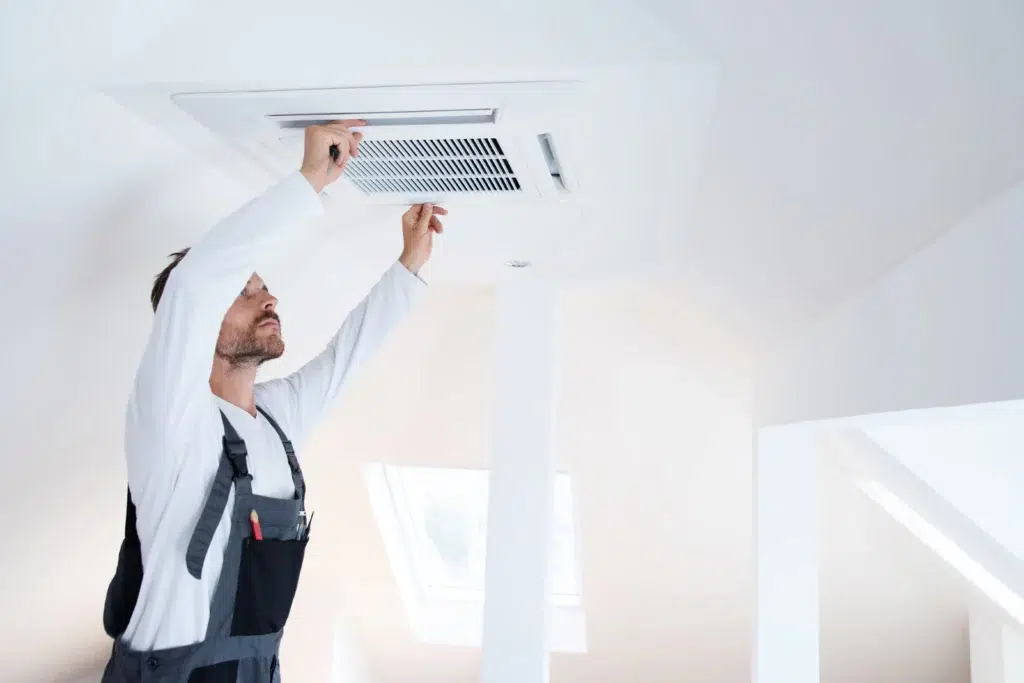
Stationary and mobile cooling units differ in their installation, flexibility, performance, and associated cost structures.
| Stationary Refrigeration Units | Mobile Cooling Units | |
| Installation | Complex, permanently installed, integrated into building structure | Quick, minimal effort, flexible |
| Duration of Use & Purpose | Permanent, continuous | Temporary, seasonal, emergency, peak load |
| Performance & Efficiency | Higher, tailored to specific needs | Variable, often lower per unit |
| Costs | Higher acquisition and installation costs, low operating costs per cooling unit | Low acquisition costs, higher operating costs per cooling unit, rental option attractive |
| Flexibility | Low (location-bound) | High (transportable, independent of location) |
Advantages & Disadvantages of Mobile Cooling Units
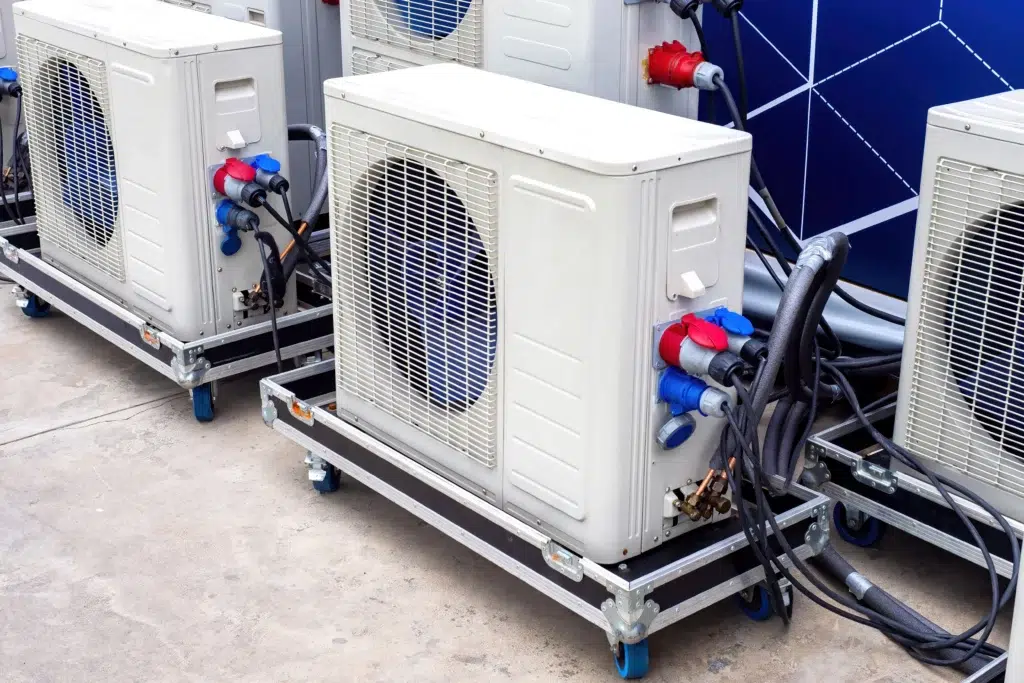
The decision for or against a mobile cooling unit strongly depends on the specific requirements and general conditions. To make an informed choice, it is important to carefully weigh the advantages and disadvantages of these systems.
Disadvantages of Mobile Cooling Units:
- Low energy efficiency: Mobile cooling systems, especially single unit air conditioners, are less energy efficient than permanently installed systems.
- Limited cooling capacities: For very large rooms or applications with high cooling requirements, mobile cooling units can reach their performance limits. Their cooling capacity is often limited compared to customized stationary systems.
- Exhaust hose (for single unit air conditioners): The exhaust hose, which directs the warm air outside, must be routed through a window or door. This can sometimes cause warm outside air to flow back in, reducing efficiency and prolonging the cooling process.
- Aesthetics & space requirements: Especially in residential or office environments, mobile cooling units can be perceived as disruptive. In addition, they often take up valuable floor space.
Advantages of Mobile Cooling Systems:
- Flexibility & Mobility: This is the biggest advantage of mobile refrigeration units. They can be quickly and easily used in various locations. This makes them ideal for temporary projects, seasonal requirements, or emergency situations.
- Quick availability & operational readiness: Mobile refrigeration units are usually ready for immediate use. This is particularly important when unexpected failures need to be bridged or a sudden cooling need arises.
- Low or no installation costs: Complex and costly installed work is not required for mobile devices. Therefore, they are particularly well suited for rental.
- Cost savings for temporary needs: For short-term projects, peaks, or emergencies, renting a mobile refrigeration unit is often more economical than purchasing and installing a fixed system.
- No building permit required: In most cases, no complex building permits or structural adjustments are necessary for the operation of mobile refrigeration units. This significantly simplifies and accelerates their use.
What Is a Mobile Cooling Unit? Conclusion and Outlook
In summary, the following characteristics of mobile cooling units can be highlighted:
- Characterized by flexibility, quick operational readiness, and mobility
- Fill an important gap that cannot be covered by permanently installed systems
- Demand-oriented cooling capacities and easy installation
Mobile refrigeration units will benefit from the continuous development of refrigeration technology in the future. Improvements are expected, especially in terms of energy efficiency, compactness, and environmental friendliness of refrigerants. Mobile cooling systems will continue to play an important role in industry in the future. In view of rising temperatures, theses developments are to be welcomed.