
Inhaltsverzeichnis
A Detailed Guide for Architects, Construction Managers, Facility Managers, and Decision-Makers
The provision of heat is a critical variable in many professional areas—be it to bridge a boiler failure, for construction heating, screed drying, or to secure industrial processes. Mobile heating centers offer the necessary flexibility and reliability for these purposes. However, the central challenge for decision-makers lies in choosing the correct performance class. Oversizing unnecessarily drives up costs, while undersizing leads to inefficient processes and delays.
Fundamentals: Which Mobile Heaters Are there – Types and Definition
What Is a Mobile Heater and what Designs Are Common?
A mobile heating center (also called a mobile heating unit, heating container, or mobile energy center) is a self-contained, ready-to-connect system for the temporary provision of heat, hot water, or process heat. It functions as a plug-and-play solution that can be quickly connected to existing heating circuits.
The common designs primarily differ in their output and mobility:
| DESIGN | TYPICAL OUTPUT | FUEL | MOBILITY & INSTALLATION LOCATION |
|---|---|---|---|
| COMPACT ELECTRIC HEATING CENTER | 3 kW – 40 kW | Electricity | Very mobile, often on wheels, suitable for indoor spaces |
| TRAILER/SKID SOLUTION | 40 kW – 1,000 kW | Oil, Gas, Electricity | High mobility (car/truck trailer), quick connection, weatherproof |
| CONTAINER SOLUTION (HEATING CONTAINER) | 1,000 kW – 2,500+ kW | Oil, Gas, Pellets | High output, robust construction, for large-scale projects and industry |
How Is the Output of a Mobile Heater Specified and what Does It Mean?
The output of a mobile heating system is specified in kilowatts (kW) and describes the maximum nominal thermal output that the unit can generate under full load.
For professional application, the distinction between nominal thermal output and the actual heat requirement is essential. The actual requirement is determined by the heat load calculation.
Important for Architects and Construction Managers: The heat load calculation according to DIN EN 12831 is the basis for correct dimensioning. It considers not only the size of the volume to be heated but also the building envelope (insulation, windows), the outside temperature (design temperature), and the desired indoor temperature. For construction heating, the increased requirement due to ventilation heat losses and moisture (e.g., during screed drying) must also be factored in.
Conclusion: Mobile heating centers are ready-to-connect plug-and-play systems, ranging in design from compact electric units (up to 40 kW) to large container solutions (up to 4,000+ kW). Correct dimensioning is based on the heat load calculation according to DIN EN 12831, not just the nominal thermal output.
Performance Classes in Detail: which Mobile Heater Matches which Application?
The classification into performance classes serves for quick orientation and assignment to the respective professional requirements:
| PERFORMANCE CLASS | TYPICAL OUTPUT | IDEAL TARGET GROUP | TYPICAL APPLICATION SCENARIOS |
|---|---|---|---|
| COMPACT/SMALL | 3 kW – 40 kW | HVAC companies, Facility Management | Screed drying, frost protection, emergency heating for single-family homes / small commercial buildings |
| MEDIUM | 50 kW – 300 kW | Construction managers, Architects, Event managers, Property managers | Construction heating for multi-family houses and small commercial properties, bridging boiler failure in schools/offices, tent heating for medium-sized events |
| LARGE/INDUSTRY | 350 kW – 1,500 kW | Energy suppliers, Industrial companies, Operators of emergency shelters | Process heat in industry, bridging for heating plants, heating large halls or storage areas, supply of local heating networks |
| VERY LARGE/SPECIAL | 1,500 – 4,000+ kW | Energy suppliers, Biogas plant operators, Large-scale industry | Overhaul of power plants and large boiler systems, feeding into large district heating networks, special applications with very high steam or heat requirements |
Conclusion: The performance classes range from Compact (3-40 kW for screed drying/small emergencies) to Medium (50-300 kW for construction heating/events) to Large/Special (350-4,000+ kW for industry, energy suppliers, and network feeding).
Selection Criteria for the Professional Target Group
The requirements for a mobile heating center vary greatly depending on the industry.
Which Factors Must Architects and Construction Managers Consider when Dimensioning a Mobile Heating System?
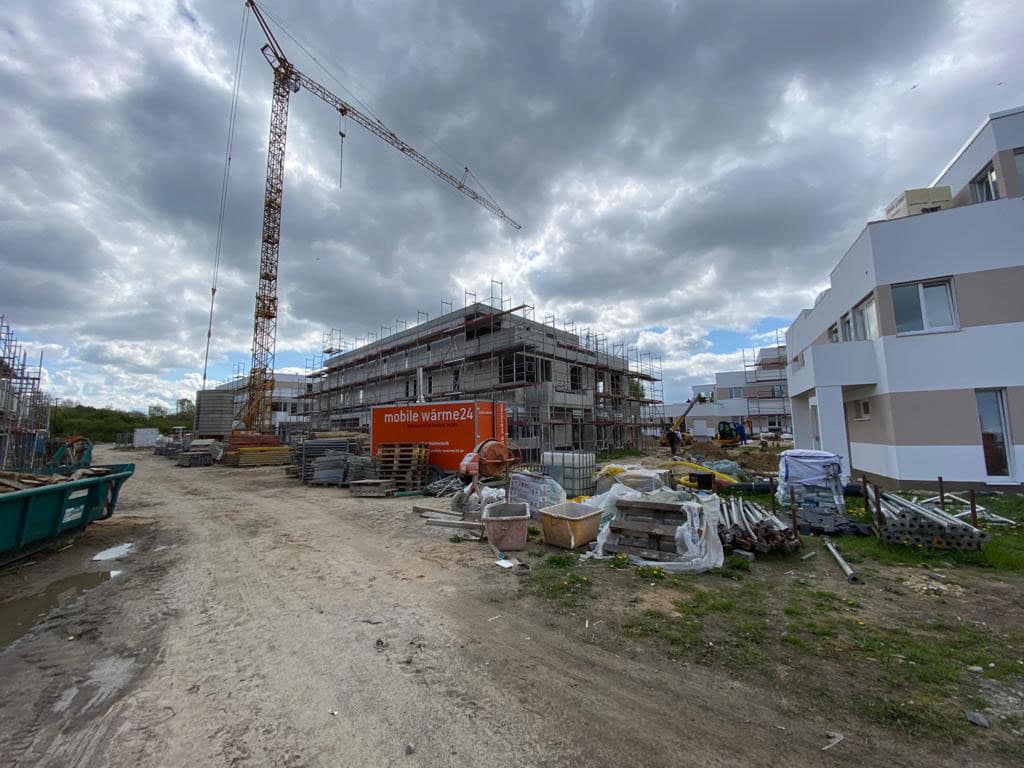
In addition to the exact heat load calculation, the following points are crucial for construction projects:
- Screed Drying: This requires special, programmable devices that can adhere to defined temperature and time profiles (e.g., according to readiness-to-cover heating). The output must cover the increased energy requirement for the evaporation of water.
- Fuel Logistics: Limited space is often available on construction sites. The choice between oil (tank logistics) and gas (connection or tank) influences the planning of the installation location and the approval procedures.
- Flexibility: The mobile heating center must be capable of handling both construction heating and hot water preparation for the construction workers.
What Must Facility Managers and Property Managers Pay Attention to when Selecting a Mobile Heating System?
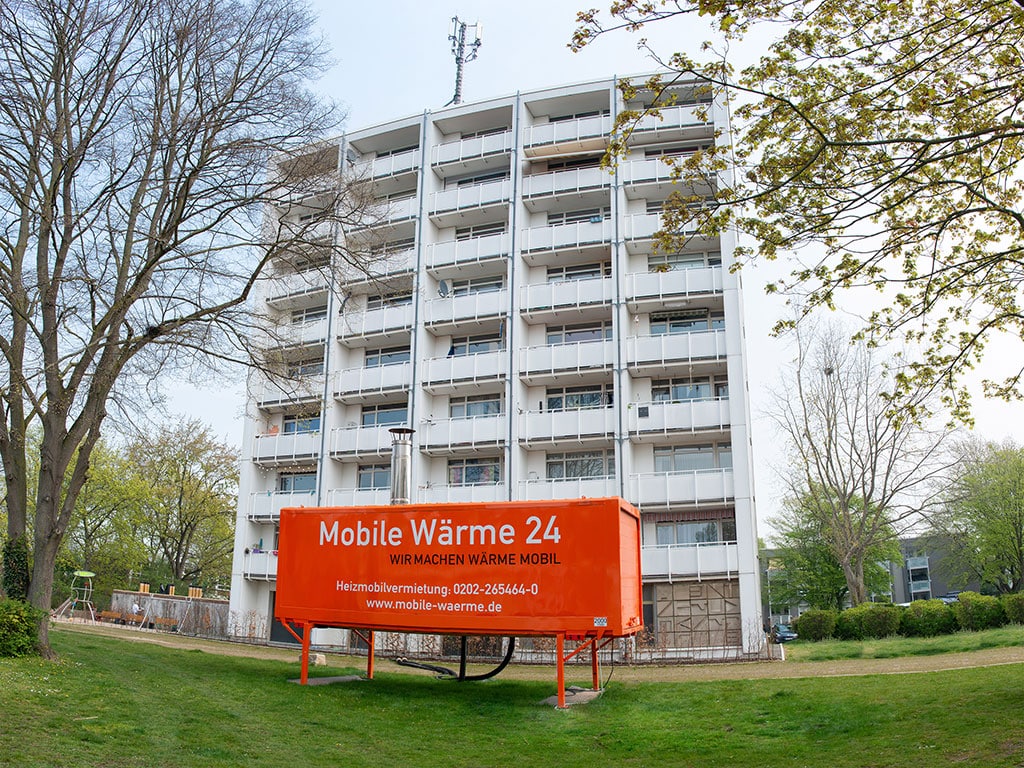
For facility management, emergency planning is paramount:
- Response Time and Redundancy: In the event of a boiler failure, quick availability (often within 24 hours) is crucial. The heating center should ideally have redundancy to prevent a total failure.
- Compactness and Installation Location: In densely built-up areas or on company premises, space is often limited. Compact trailer or skid solutions are often a better choice here than large containers.
- Fuel Availability: Connection to the existing infrastructure (e.g., existing gas lines) can simplify logistics.
What Role Do Mobile Heating Centers Play for Energy Suppliers and Biogas Plant Operators?
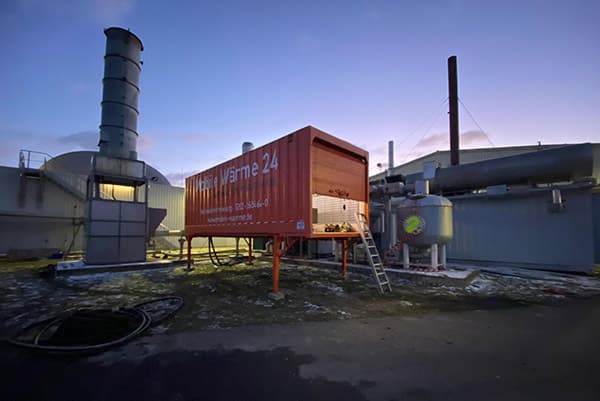
In energy supply, mobile heating centers primarily serve supply security and peak load coverage.
- Bridging during Overhauls: During the maintenance or replacement of large boiler systems in heating plants or biogas plants, mobile heating centers ensure that the heat supply to the connected networks (local or district heating) is seamlessly maintained.
- Network Feeding: High-output units (often 1,000 kW and more) can feed directly into the heating network. Here, the correct pressure and temperature parameters as well as the compatibility of the connections (flanges) are critical.
- Biogas Plant: Mobile heating systems can temporarily provide heat for the fermenter if the energy supply fails, or serve to cover seasonal peak loads in the connected heating network.
What Is Crucial for Event Managers and Operators of Emergency Shelters when Selecting Mobile Heating Systems?
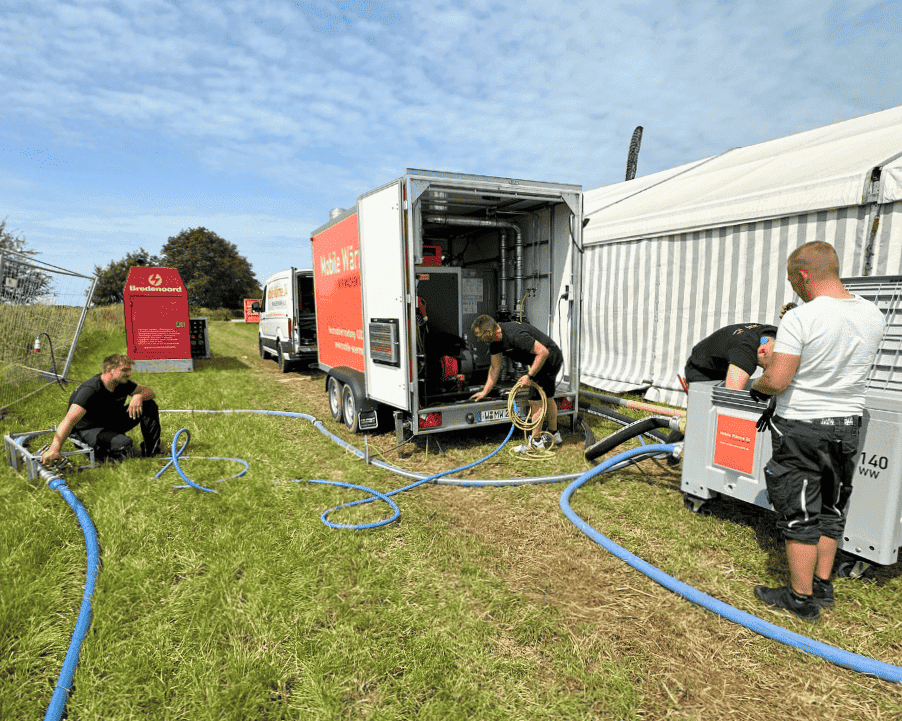
Here, comfort and logistics are paramount.
- Air Heating vs. Hot Water Heating: For events (tents, halls) or emergency shelters, mobile air heating is often preferred because it quickly heats large volumes and does not require complex piping.
- Noise Emission: Especially at events or in residential areas, the sound power level of the system is an important criterion. Specially insulated containers or the choice of electric heating centers may be necessary.
- Quick Assembly/Disassembly: The systems must be ready for use quickly after the event or in case of short-term need and be dismantled just as quickly.
Conclusion: The selection criteria are industry-specific: Architects/construction managers focus on heat load and screed drying, facility managers on response time and redundancy; energy suppliers on supply security and network feeding; event managers on logistics and noise emission.
Technical and Economic Aspects
What Role Does Efficiency Play in Mobile Heating systems?
Efficiency is a decisive factor for operating costs.
- Combustion Technology: Modern mobile heating centers, especially those operated with gas or oil, often use combustion technology. This technology recovers additional heat from the exhaust gases and can increase efficiency to over 100% (based on the calorific value).
- Efficiency at Partial Load: Since mobile heating systems rarely run continuously at full load, efficiency in partial load operation is of great importance. A system that operates inefficiently in the partial load range can unnecessarily increase operating costs.
Rent or Buy – when is which Option Worthwhile for Whom?
The decision between renting and buying depends on the frequency and predictability of the requirement. Detailed information on this can be found in our blog post Rent a Mobile Heating Unit? An Overview of Pros and Cons.
| OPTION | ADVANTAGES | DISADVANTAGES | IDEAL TARGET GROUP |
|---|---|---|---|
| RENT | No capital commitment, immediate availability, maintenance/service included, latest technology | Higher costs for very long rental periods, no individual adjustments | Facility Managers (emergencies), Construction Managers (seasonal projects), Event Managers |
| BUY | Constant availability, individual customization, full cost control with high utilization rate | High initial investment, maintenance and storage costs, risk of obsolescence | Energy Suppliers (fixed redundancy), Industrial Companies (continuous process heat) |
Conclusion: Economic viability is significantly determined by efficiency in partial load operation and the use of modern condensing technology. The decision between renting (short-term need, emergencies) and buying (continuous, predictable need) depends on the frequency and predictability of use.
Conclusion: Which Mobile Heater for Which Requirement – The Performance Classes as the Key to Efficiency
Choosing the right performance class for mobile heating centers is far more than just a question of kilowatts. It is a strategic decision that directly influences project efficiency, adherence to schedules, and operating costs.
For all professional decision-makers, the following applies: Do not rely on estimates. A professional needs assessment by the provider or a specialist is essential to find the optimal balance between output, fuel type, and cost. Only in this way can the mobile heating center optimally fulfill its role as a reliable and efficient energy supplier.
Your Next Step: Precise Needs Assessment
Choosing the right performance class is complex and requires expertise. We support you in finding the optimal solution for your project.
Contact our experts for a non-binding and precise needs analysis—they know which mobile heater is right for your requirements:
Or directly request your desired heating output when you know which mobile heater you need:
References:
DIN EN 12831: Heizsysteme in Gebäuden – Verfahren zur Berechnung der Norm-Heizlast. (seen on 11/24/2025).
Disclaimer: This content was created with great care. However, we cannot guarantee its accuracy, completeness, or currency. Our site contains links to external websites. We have no influence on the content of these sites and therefore accept no liability for them.